
None of our instructors at CCM are completely self-taught. But John Gass comes close. John was working as a psychotherapist at a mental health clinic in Tacoma, Washington more than 20 years ago 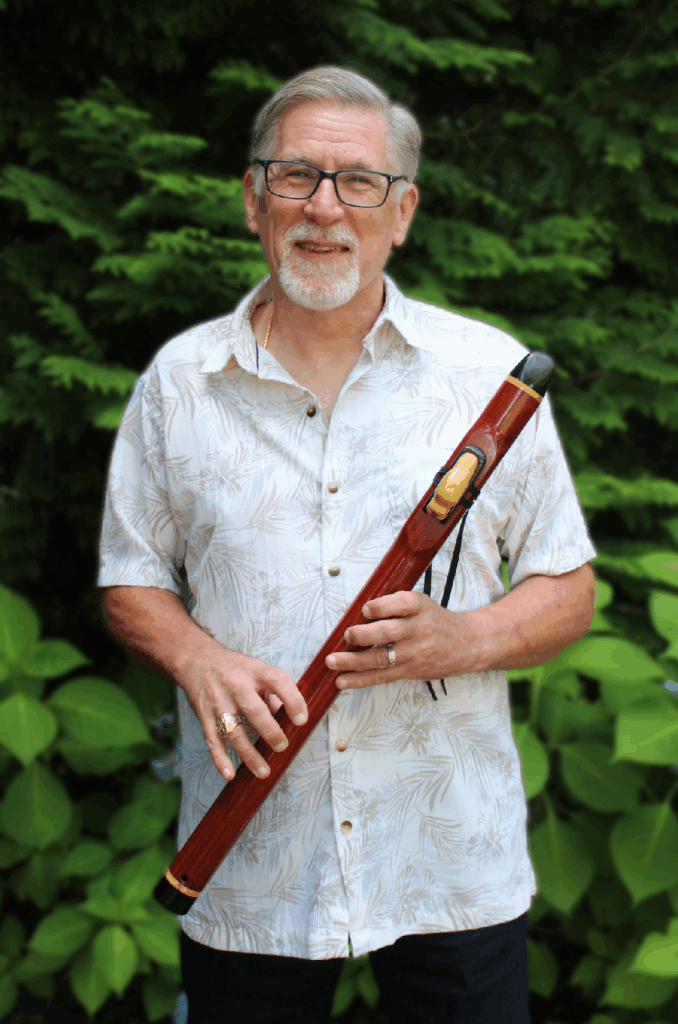 when his life changed course. “I wanted something that would help me start my day feeling grounded before engaging with all the emotions that would come through my door,” John recalls. “One of my colleagues suggested listening to Native American flute music.”
John did — and soon realized that listening wasn’t enough. He wanted to play, so he bought a Native American style flute. It came with a DVD, which John presumed would include instructions on how to play basic songs. Instead, he says, the DVD offered profound advice: “Take the time to learn what sounds your flute can make. Learn to start playing the music that wants to come from you.”
Different Choices, Different Voices
Suffice to say that John took the time to learn. Now he’s passionate about helping others do the same.
Native American style flute is ideal for helping students find the music within. “There is a wonderful amount of variety in these instruments,” John says. “To begin with, each flute is a single key, much like harmonicas. And each flute only plays one octave, with a couple of notes above the octave possible. For any given scale you can usually find flutes in three or four different octaves — high, mid-range, low, and bass or contra bass.”
Each flute also has a distinct construction. “Beyond the tunings and octaves, the material the flute is made from, and the ‘voice’ that the flute maker builds into the flute, create unique sounds,” John says. “I can take five flutes, all in the same key but made by different flute makers using different woods, and each will sound a little different than the others.”
Play it by Ear
That lack of uniformity is conducive to improv and experimentation. “This is such a simple, intuitive, instrument to play,” John says. “Players who have experience with other flutes, especially ‘silver flutes,’ find this a much easier instrument to learn and play. For one thing, there is no embouchure.”
In addition, John says, “Students seem to love that we don’t use sheet music. We do sometimes use tablature, including writing out our own tunes. But we mostly rely on playing by ear, and playing intuitively — especially when playing duets.”
Finding a Way
Appropriate for someone who specializes in an unconventional instrument, John took a nontraditional route to becoming an instructor. It started when he joined the Army Special Forces. “A big part of my job was teaching,” he says. “And a big part of that was being able to determine the needs of our students, to meet them where they were, and to adapt as training progressed. I think this is when I really learned to love teaching.”
Later, as a psychotherapist, John took a similar approach. “A big part of my role was to help clients learn new skills so that they could have a more well-rounded life,” he says. “As with military training, it was important to understand where my clients were, what their needs were, and what their goals and hopes were. I would adapt what we were doing as their needs and skills changed. And we only progressed at the pace the client could handle.”
Playing Well with Others
John uses a similar approach at CCM. “That’s really the basis for my philosophy as a music instructor,” John says. “Meet the students where they are, understand what they are hoping to learn, be ready to adapt as necessary, and don’t leave anyone behind.”
He learned another important lesson from his Special Forces training: “Everything started with how to connect with students. Relationship is so important to how the flow of information will go.”
John discovered a different aspect of relationship and flow when he teamed up with Brenda Fingold, a singer, songwriter, and guitarist, in the duo Montana Spark. “We do a blend of Brenda supporting me with her guitar on some songs, and me supporting her with flute on others,” John says. “We’ve even added some flute duets to our repertoire. Those experiences led me to add components of that to my course. We explore what it’s like to not have to carry a whole tune by yourself. I bring in a guitar player for one class and let students have the experience of being supported by another instrument as well as supporting another instrument.”
Bringing it Home
John says CCM provides an ideal venue for his style of teaching. “I love the emphasis on community, and the thread of believing in the value of music to individuals, communities, and humanity as a whole,” he says. “My philosophy is to share what I know without being too directive. We can all learn from each other. It’s a pretty special experience as a teacher when I can watch students complimenting and supporting each other’s development. I think that speaks to people feeling a level of comfort and safety in the class, which really facilitates learning and growth.”
As a teacher, John’s favorite memory is of the student who told him at the end of the course that they had never dreamed that they would be able to play an instrument. “Now,” that student said, “I have the joy of creating my own music.”
Original Article: https://concordconservatory.org/opus-newsletter/august-2025-opus/#Article1
